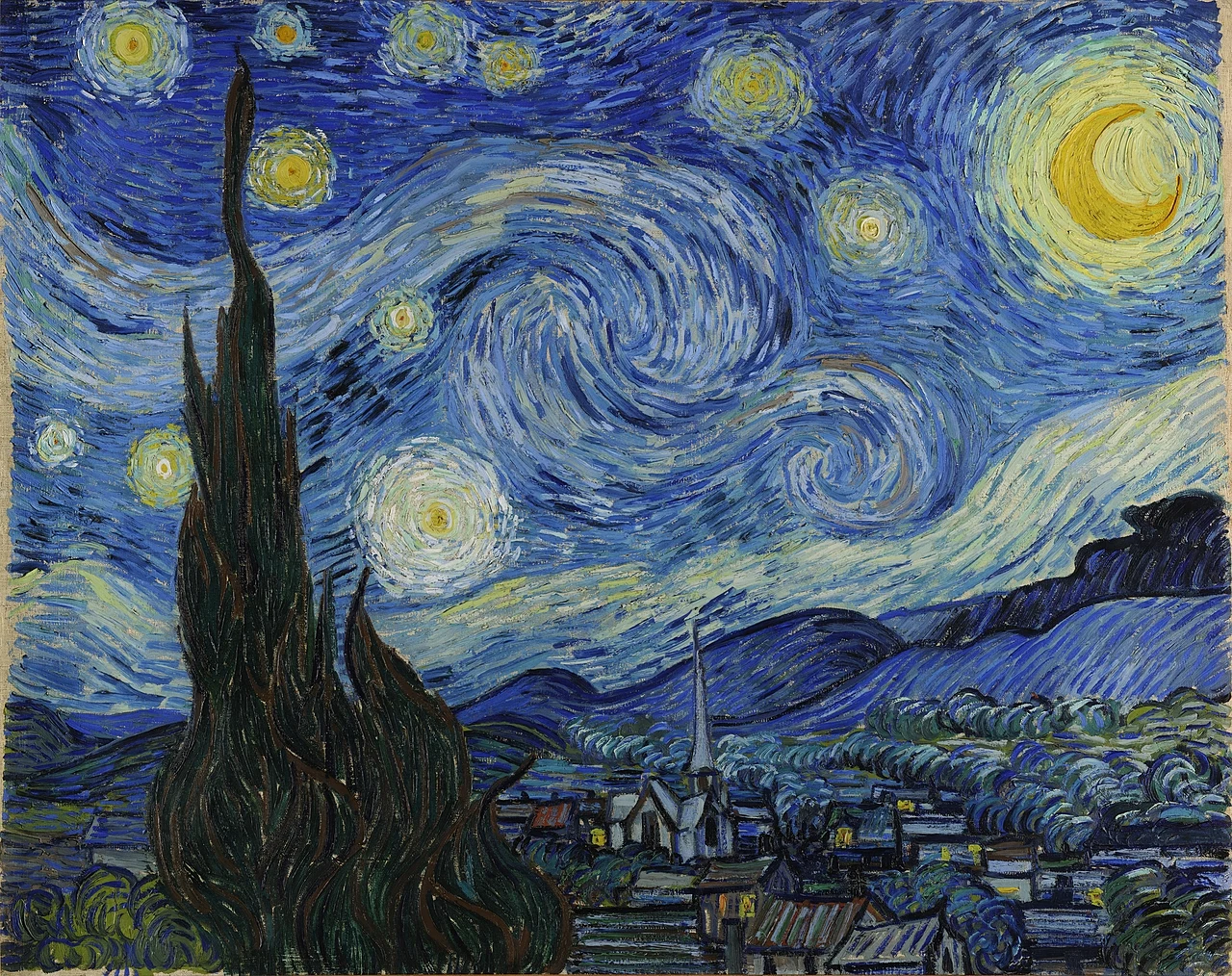
The Starry Night
by Vincent van Gogh, 1889
Details
- Year
- 1889
- Medium
- Oil on canvas
- Size
- 73.7 cm × 92.1 cm
- Gallery
- Gallery 5, Floor 5
Estimated Value
$200M
Expert estimate
On a June night in 1889, Vincent van Gogh looked out from his room at the Saint-Paul-de-Mausole asylum in southern France and painted one of the most recognized images in Western art. The Starry Night shows a village sleeping beneath a swirling sky, where eleven yellow stars blaze like fireworks and a crescent moon radiates an almost electric glow. The cypress tree in the foreground rises like a dark flame, connecting earth to the turbulent heavens above.
Van Gogh had committed himself to the asylum following a mental breakdown in Arles, during which he famously severed part of his own ear. Despite his fragile state, or perhaps because of it, he produced some of his most visionary work during this period. The Starry Night was painted from memory and imagination rather than direct observation, which may account for its dreamlike intensity. The rolling, wave-like forms of the sky have no equivalent in nature, yet they feel emotionally true: a visual expression of the overwhelming forces Van Gogh sensed churning beneath the surface of the visible world.
The painting belongs to Post-Impressionism, a movement that pushed beyond the optical concerns of the Impressionists toward more personal and symbolic expression. Van Gogh's thick, energetic brushstrokes and bold color contrasts influenced generations of artists, from the Expressionists to the Abstract Expressionists. He sold only a handful of paintings during his lifetime and died by suicide in 1890, just a year after creating this work. Today The Starry Night hangs at The Museum of Modern Art in New York, where it draws larger crowds than perhaps any other work in the collection. Its swirling blue and gold palette has made it one of the most reproduced images in luxury wall art.
Historical Significance
Created during emotional turmoil, it became an icon of modern art with its bold brushwork and emotional intensity.