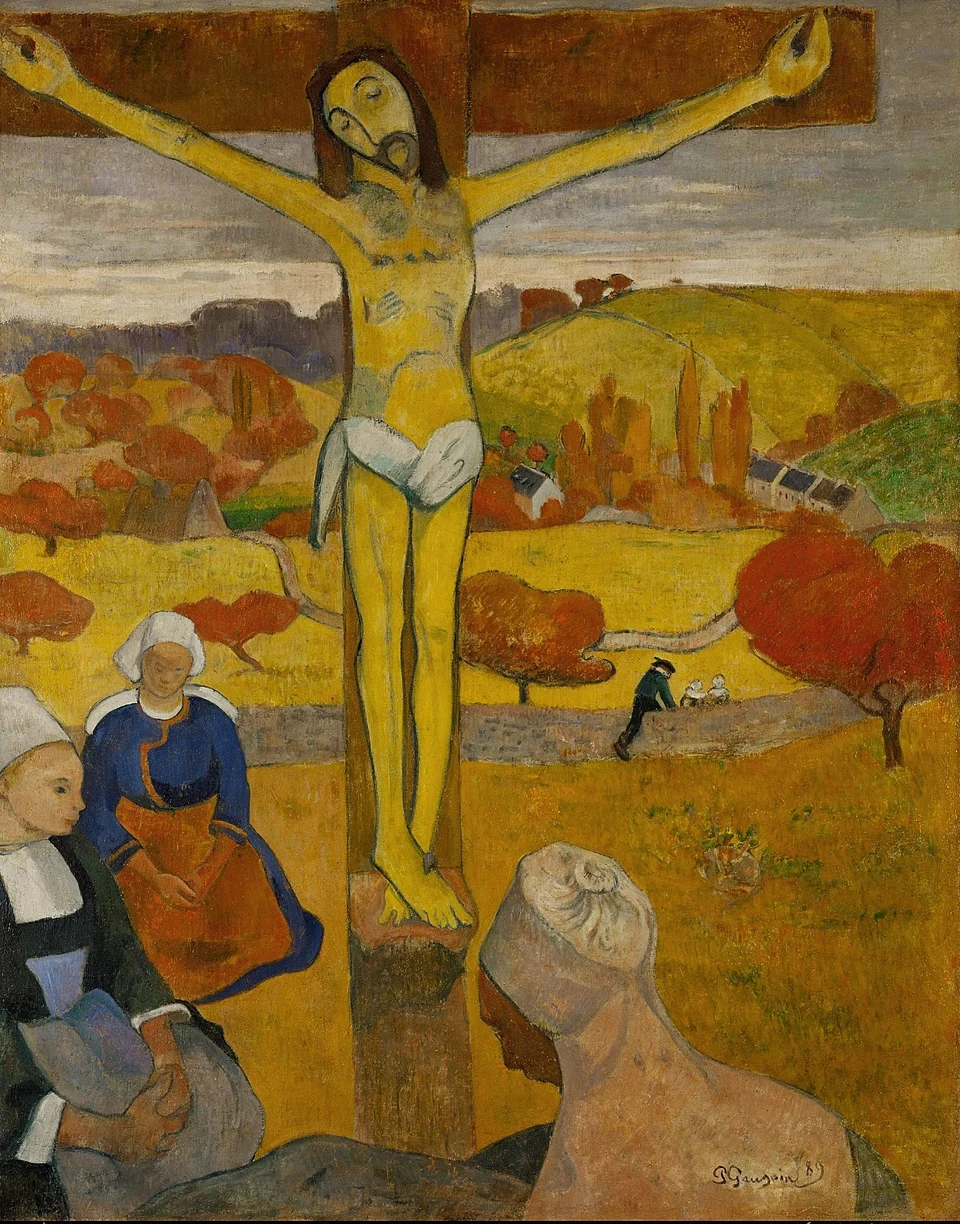
The Yellow Christ
by Paul Gauguin, 1889
Details
- Year
- 1889
- Medium
- Oil on canvas
- Size
- 92.1 cm × 73.4 cm
Paul Gauguin painted The Yellow Christ in 1889 during his time in Pont-Aven, Brittany. The work depicts a crucified Christ rendered in bright yellow, based on a 17th-century wooden crucifix from the nearby Trémalo Chapel. Three Breton women in traditional dress kneel at the foot of the cross against an autumn landscape.
Gauguin chose the bold yellow color to express his feelings about the isolated life and deep piety of the Breton peasants. The harvest season in Brittany carried spiritual significance, as grain was believed to mirror the Christian cycle of death and rebirth. This Symbolist approach rejected naturalistic color in favor of emotional truth.
The painting has a dramatic wartime history. Confiscated by the German Army in 1940, it passed through the Louvre and Jeu de Paume before ending up at the German embassy. After the war, it was returned and sold to the Buffalo AKG Art Museum in 1946, where it remains today.