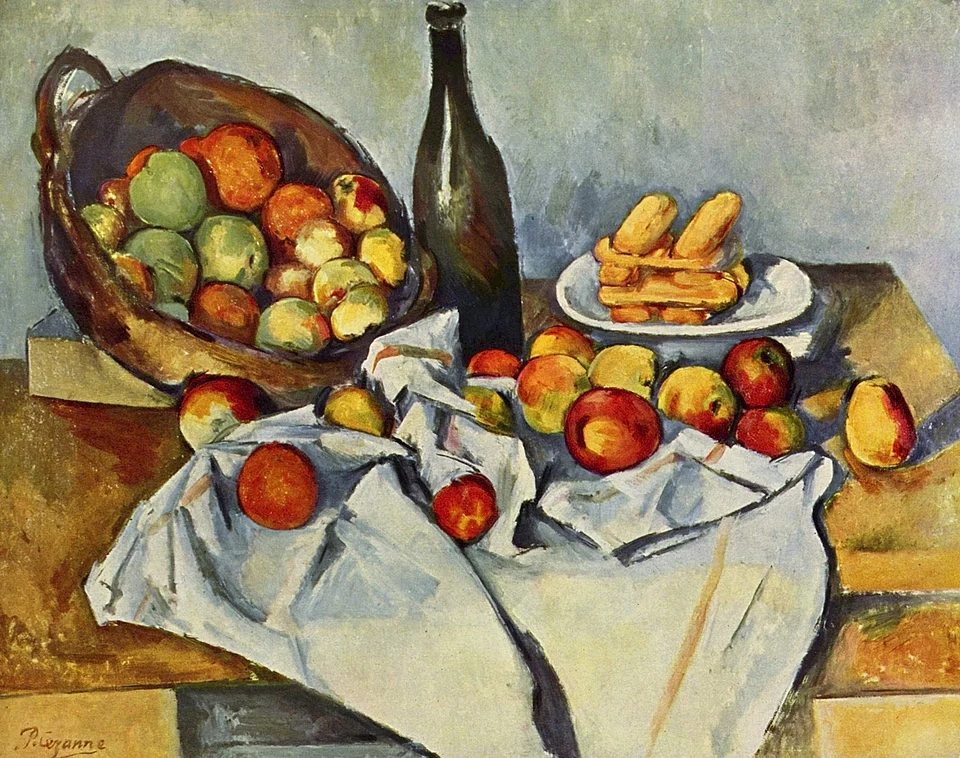
The Basket of Apples
by Paul Cézanne, 1895
Details
- Year
- 1895
- Medium
- Oil on canvas
- Size
- 65 cm × 80 cm
Paul Cézanne painted The Basket of Apples around 1893, one of his most deliberately disjointed compositions. The tablecloth bunches in sculptural folds. The basket tips forward at an impossible angle. The table's two sides don't align. The wine bottle leans. Nothing sits quite right, and that's the point.
Cézanne rejected the single-viewpoint perspective that had dominated Western painting for centuries. He painted objects from multiple angles simultaneously, showing what he saw as he moved around them. This approach would later inspire Picasso and Braque to develop Cubism. The "Father of Modern Art" nickname stems largely from works like this.
The painting measures about 65 by 80 centimeters and belongs to the Art Institute of Chicago. It's one of Cézanne's rare signed works, part of an important 1895 exhibition organized by dealer Ambroise Vollard. The warm earth tones and solid brushstrokes give the composition density that realistic still lifes lack.