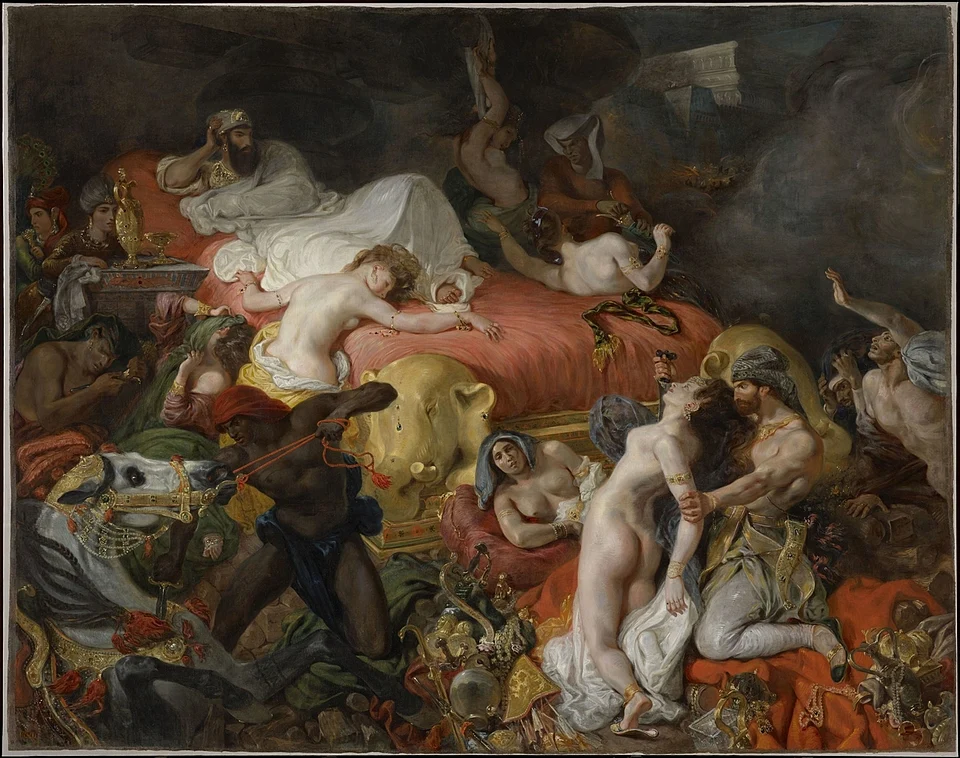
The Death of Sardanapalus
by Eugène Delacroix, 1827
Details
- Year
- 1827
- Medium
- Oil on canvas
- Size
- 392 cm × 496 cm
Eugène Delacroix painted The Death of Sardanapalus in 1827, inspired by Lord Byron's 1821 play about the legendary Assyrian king. Facing military defeat and humiliation, Sardanapalus orders the destruction of everything he treasured: his horses, slaves, and concubines will burn with him on a vast funeral pyre. He reclines on a bed, watching the chaos.
The painting explodes with violence and red fabric. Bodies twist in agony. Servants slaughter horses. The composition tilts directly toward the viewer, breaking classical rules about ordered space. Critics at the 1827 Salon called it "the fanaticism of ugliness." Delacroix reveled in Byronic drama, and this is Romanticism at its most extreme.
The canvas is monumental: 392 by 496 centimeters, roughly 12 by 16 feet. It hangs at the Louvre in Paris. Delacroix made a smaller replica in 1844, now at the Philadelphia Museum of Art. The original inspired a Berlioz cantata and an unfinished Liszt opera.