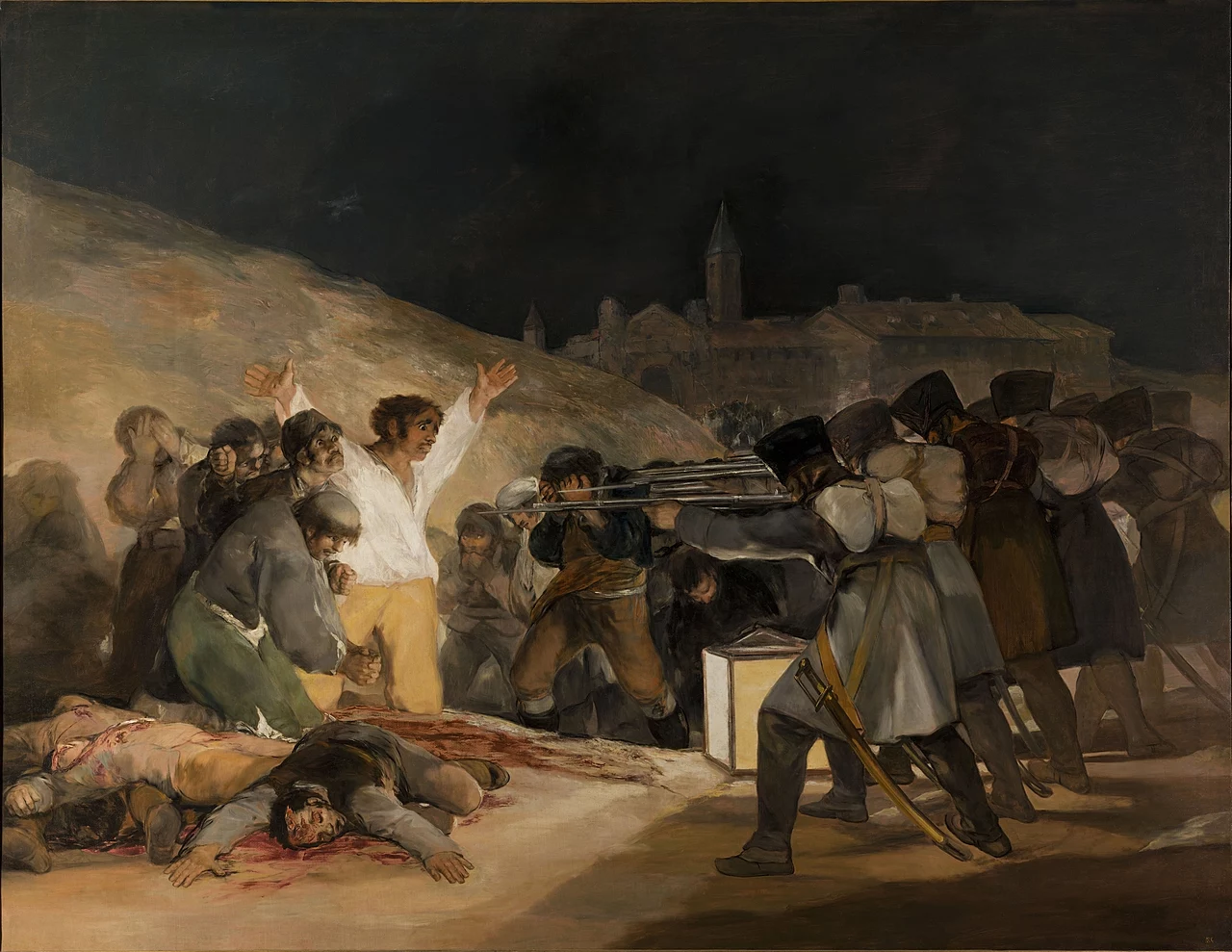
The Third of May 1808
by Francisco Goya, 1814
Details
- Year
- 1814
- Medium
- Oil on canvas
- Size
- 268 cm × 347 cm
- Gallery
- Room 64
Francisco Goya painted The Third of May 1808 in 1814, commemorating Spanish resistance to Napoleon's occupation. French soldiers form a faceless firing squad, their backs to us, rifles leveled at a group of civilians. At center, a man in a white shirt throws his arms wide in a pose echoing crucifixion, his face caught between terror and defiance. Bodies of the already executed lie in pools of blood at his feet.
The executions were real. On May 3, 1808, French troops shot hundreds of suspected rebels on a hill outside Madrid. Goya may have witnessed the aftermath. He painted this work six years later, after the French had been expelled, creating what many consider the first modern war painting. Unlike earlier battle scenes glorifying heroism, Goya showed war as butchery.
The Romantic master served as court painter to successive Spanish kings while privately documenting the horrors he witnessed. The Third of May hangs at Museo del Prado in Madrid, often paired with its companion piece depicting the uprising of May 2nd.
Historical Significance
A landmark in the history of art, considered the first great modern painting of war.