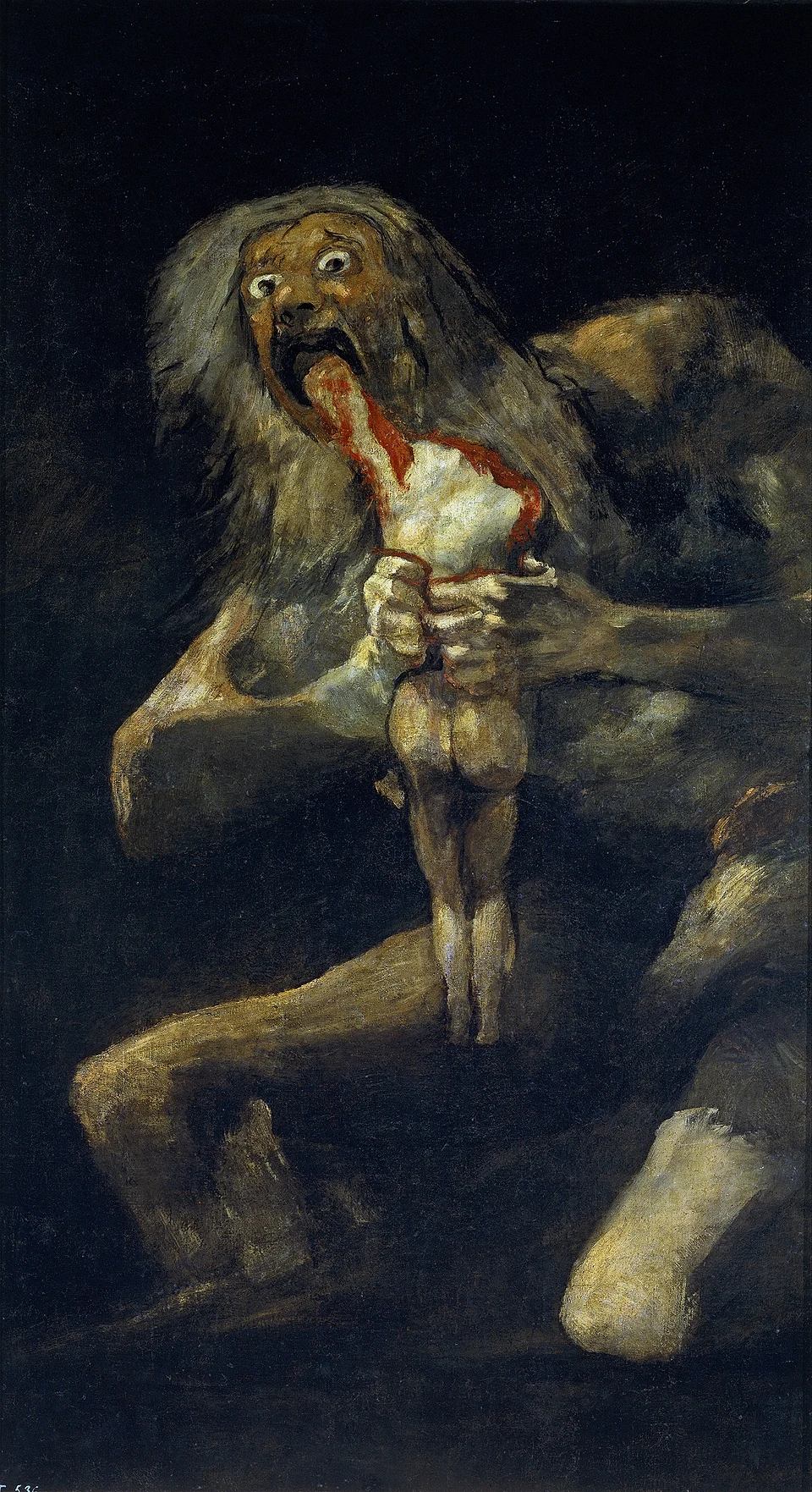
Saturn Devouring His Son
by Francisco Goya, 1823
Details
- Year
- 1823
- Medium
- Oil mural transferred to canvas
- Size
- 143 cm × 81 cm
- Gallery
- Black Paintings Room
A wild-eyed giant clutches a bloody corpse, cramming it into his gaping mouth. Francisco Goya painted Saturn Devouring His Son directly onto the walls of his farmhouse outside Madrid sometime between 1819 and 1823. He never titled it, never exhibited it, and likely never intended anyone to see it. The painting was one of fourteen "Black Paintings" that decorated his home during his final years in Spain.
The subject comes from Roman mythology: the god Saturn, fearing a prophecy that his children would overthrow him, devoured each one at birth. Goya's interpretation is pure nightmare. Saturn's bulging eyes, his grip on the mangled body, the darkness pressing in from all sides transform classical myth into psychological horror. Some scholars see the image as a meditation on Spain consuming its youth in civil conflict.
Goya was in his seventies, deaf, and increasingly isolated when he created the Black Paintings. After his death, the murals were transferred to canvas and eventually donated to Museo del Prado in Madrid, where they remain among the most disturbing images in any museum.
Historical Significance
Part of the famous Black Paintings series, representing Goya's dark psychological exploration.