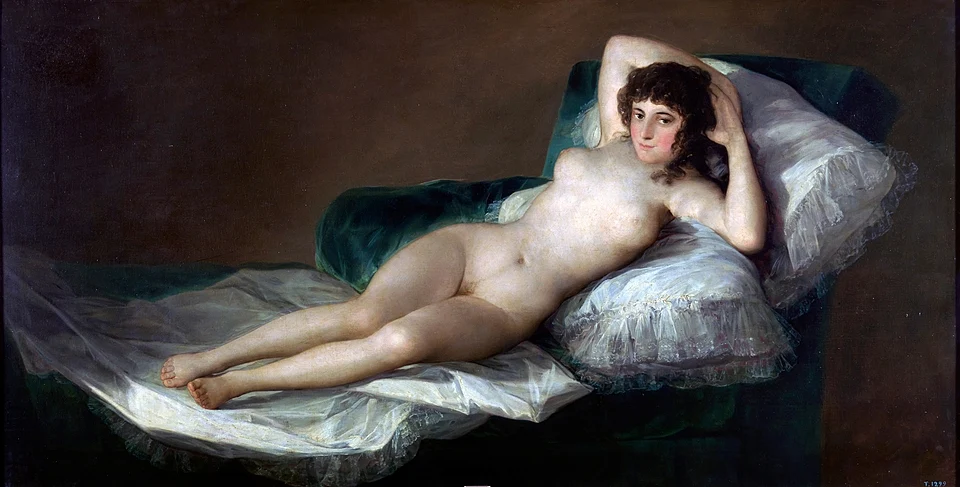
The Nude Maja
by Francisco Goya, 1800
Details
- Year
- 1800
- Medium
- Oil on canvas
- Size
- 97 cm × 190 cm
Francisco Goya painted The Nude Maja between 1797 and 1800, one of the earliest Western artworks to depict a nude woman looking directly at the viewer without mythological justification. She lies on green velvet cushions, completely unashamed. No Venus attributes, no classical excuse. Just a naked woman meeting your gaze.
Prime Minister Manuel de Godoy kept the painting in a private room reserved for nude works. When the Spanish Inquisition discovered it in 1808, they summoned Goya to explain himself. He escaped prosecution by citing Titian and Velázquez as precedents, but the paintings remained confiscated until 1836. They were hidden in a government basement, off-limits to the public.
The canvas measures 98 by 191 centimeters and now hangs at the Museo del Prado in Madrid beside its clothed companion. The model's identity remains unknown. Her frank sensuality and the Inquisition scandal made this one of the most discussed paintings in art history.