Wikimedia Commons • Public Domain
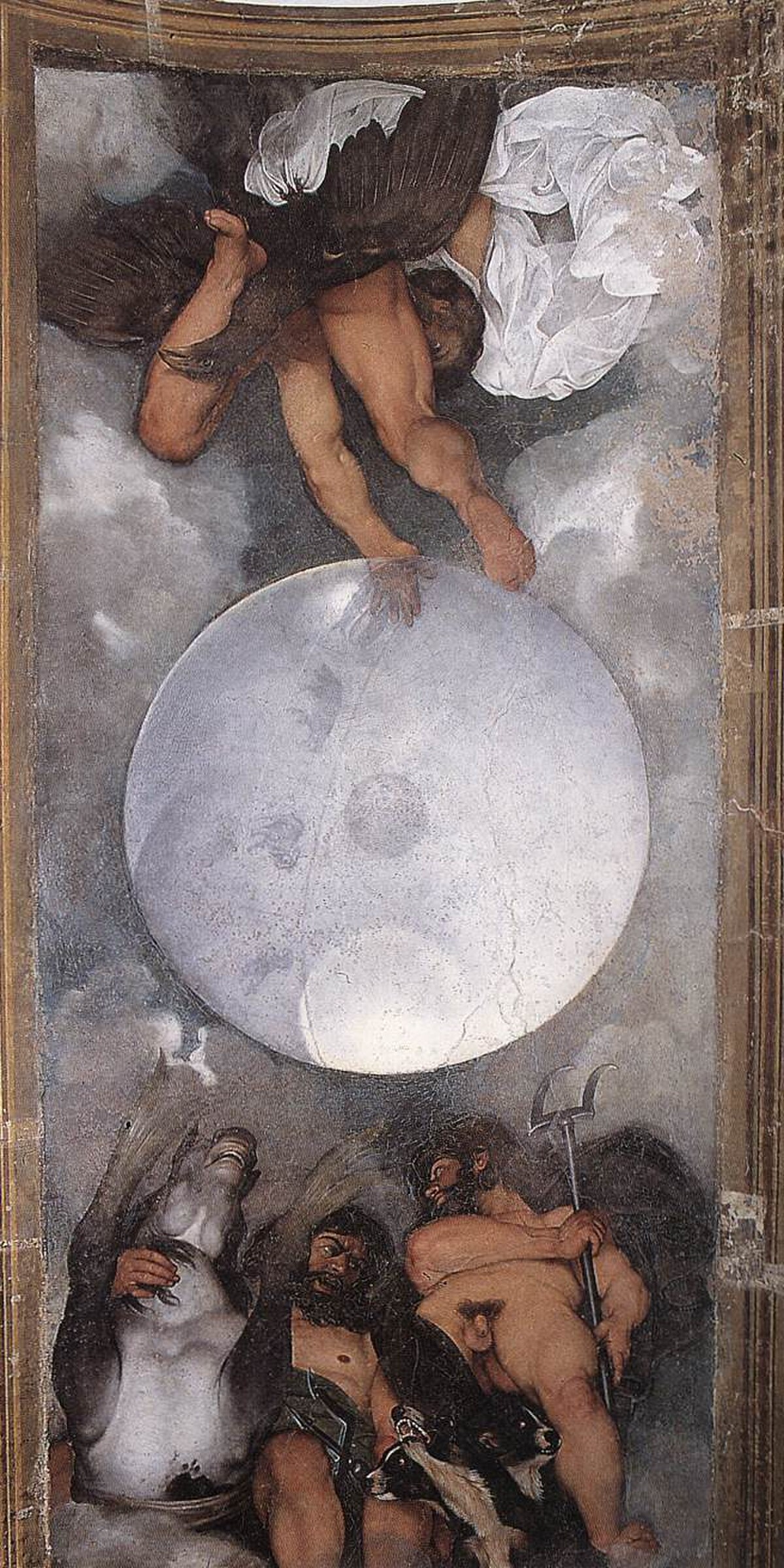
Jupiter, Neptune and Pluto
by Caravaggio
Italian artist Caravaggio painted this notable ceiling around 1597 for his patron Cardinal Francesco Maria del Monte. It is Caravaggio's only mural and his only ceiling painting, executed in oils on plaster rather than traditional fresco technique. The small room measures just 2.75 meters wide, making the dramatic foreshortening even more impressive when viewed from below.
The three gods are identified by their attributes: Jupiter by the eagle, Neptune by the hippocamp (sea-horse), and Pluto by Cerberus, the three-headed dog of the underworld. Jupiter reaches out to move a celestial sphere showing the Sun revolving around Earth. The painting functioned as an alchemical allegory for Del Monte's laboratory: Jupiter represents sulphur and air, Neptune represents mercury and water, and Pluto represents salt and earth.
Early biographers suggest Caravaggio created this work to disprove critics who claimed he couldn't handle perspective. All three gods apparently use Caravaggio's own face. The painting was covered over at some point, possibly because Pluto is shown completely nude, and wasn't rediscovered until 1968. It remains in place at the Casino dell'Aurora in Rome, part of the former Villa Ludovisi estate.