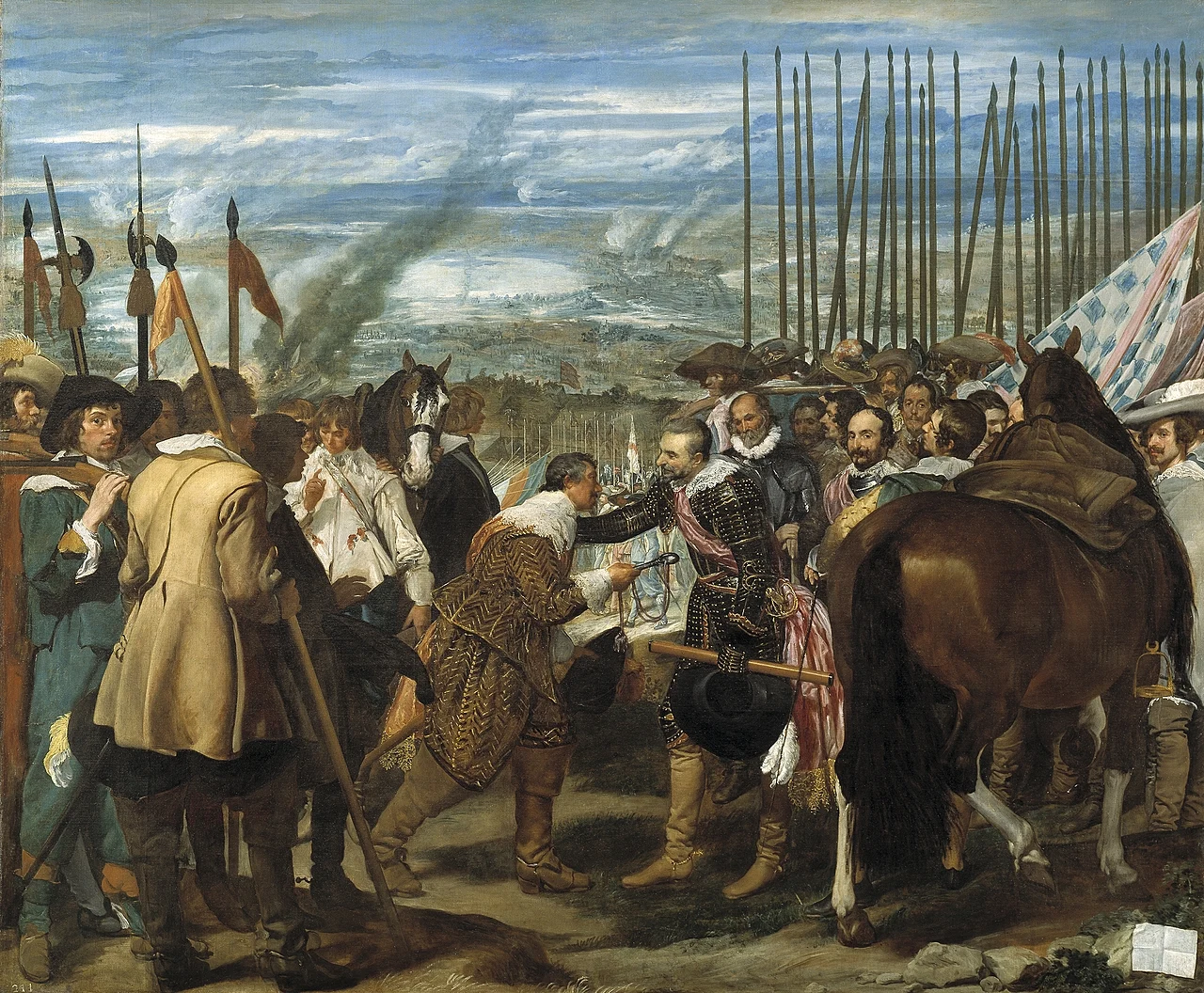
The Surrender of Breda
by Diego Velázquez, 1635
Details
- Year
- 1635
- Medium
- Oil on canvas
- Size
- 307 cm × 367 cm
Diego Velázquez painted The Surrender of Breda between 1634 and 1635, commemorating Spain's 1625 victory over Dutch forces at Breda. The painting shows General Ambrosio Spinola receiving the city's keys from Justinus van Nassau. Spinola places his hand on the defeated commander's shoulder, preventing him from kneeling. It's a gesture of respect unusual in victory paintings.
The composition is dominated by lances on the Spanish side, giving the work its popular name, Las Lanzas (The Lances). Critic José Ortega y Gasset called them "the backbone of the entire picture." The Dutch side shows fewer weapons, mostly lowered. Smoke rises in the background from what remains of the siege.
The massive canvas measures 307 by 367 centimeters and hangs at the Museo del Prado in Madrid. Philip IV commissioned it for the Hall of Kingdoms at the Buen Retiro Palace, along with eleven other battle scenes designed to impress foreign ambassadors. Velázquez had traveled with Spinola to Italy in 1629, so he knew the general personally. Spinola died in 1630, making this also a posthumous portrait.