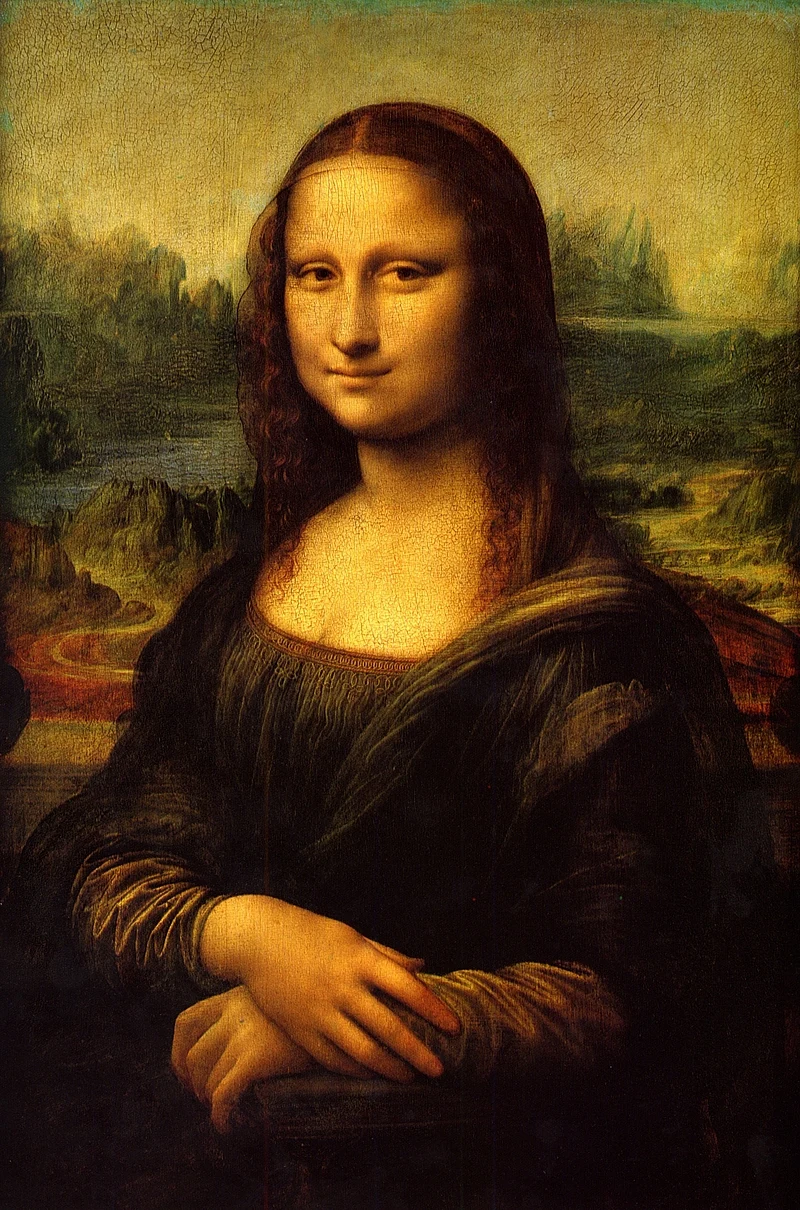
Mona Lisa
by Leonardo da Vinci, 1503
Details
- Year
- 1503
- Medium
- Oil on poplar panel
- Size
- 77 cm × 53 cm
- Gallery
- Salle des États
Estimated Value
$900M
Insurance valuation
The most famous painting in the world hangs behind bulletproof glass in a climate-controlled case at The Louvre, surrounded daily by crowds pressing forward to photograph a woman's mysterious smile. Leonardo da Vinci began the Mona Lisa around 1503 and may have continued working on it for years afterward. The sitter is traditionally identified as Lisa Gherardini, wife of a Florentine merchant, though her identity has been debated for centuries.
What makes this small portrait so striking? Leonardo employed sfumato, a technique of softening transitions between colors and tones so that edges seem to dissolve into shadow. The corners of the subject's mouth and eyes are deliberately ambiguous, which is why her expression seems to shift as we look at her. She appears to smile, then doesn't. She watches us, then seems to look past us. This psychological uncertainty was radical in portraiture and has fascinated viewers ever since.
The landscape behind her is equally strange: winding rivers, rocky crags, and distant peaks that don't correspond to any real location. Leonardo painted the left and right backgrounds at different horizon levels, adding to the painting's subtle disorientation. The Renaissance master carried this portrait with him for years, never delivering it to its commissioner. After his death in France, it entered the royal collection and eventually became state property.
The painting's fame exploded after it was stolen from the Louvre in 1911 by an Italian handyman who believed it belonged in Italy. The theft made international headlines and turned the Mona Lisa into a celebrity. When it was recovered two years later, crowds lined up to see it. That fame has only grown, making this modest portrait of a merchant's wife the most visited artwork on Earth.
Historical Significance
Famous for its sfumato technique and the subject's enigmatic expression. Its theft in 1911 made it world-famous.