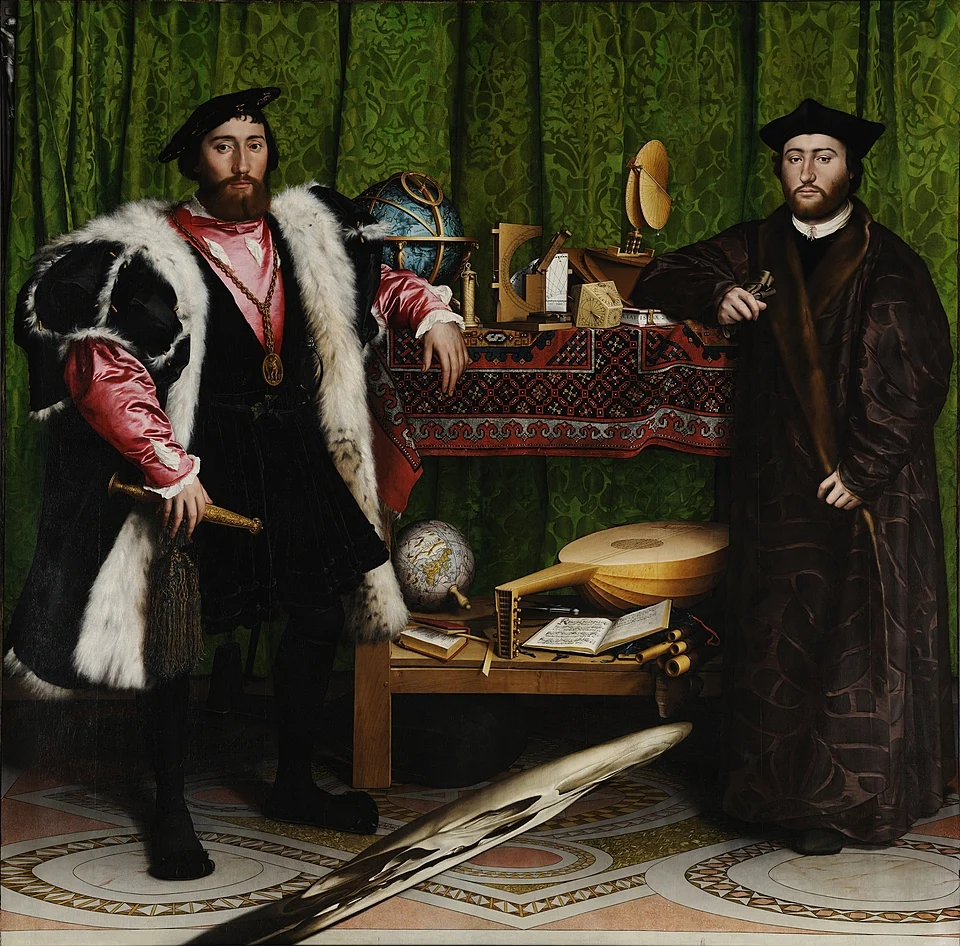
The Ambassadors
by Hans Holbein the Younger, 1533
Details
- Year
- 1533
- Medium
- Oil on oak
- Size
- 207 cm × 209.5 cm
Hans Holbein the Younger painted this double portrait in 1533, depicting two French diplomats in London: Jean de Dinteville and Georges de Selve. The men stand on either side of a two-tiered table laden with objects representing the quadrivium: arithmetic, geometry, music, and astronomy. Globes, instruments, and a lute with a broken string fill the composition with symbolic detail.
The painting's most famous feature is the distorted skull stretched across the bottom. Viewed from the correct angle, the anamorphic shape resolves into a clear memento mori, reminding viewers of death's inevitability. This hidden element transforms a display of worldly accomplishment into a meditation on mortality. A tiny crucifix partially hidden by a curtain in the upper left offers the promise of salvation.
Holbein created this work at nearly life-size, its subjects looming over viewers with their rich clothing and impressive array of learning. It hangs in the National Gallery in London, where the skull's optical trick draws crowds daily.