Wikimedia Commons • Public Domain
Hunting
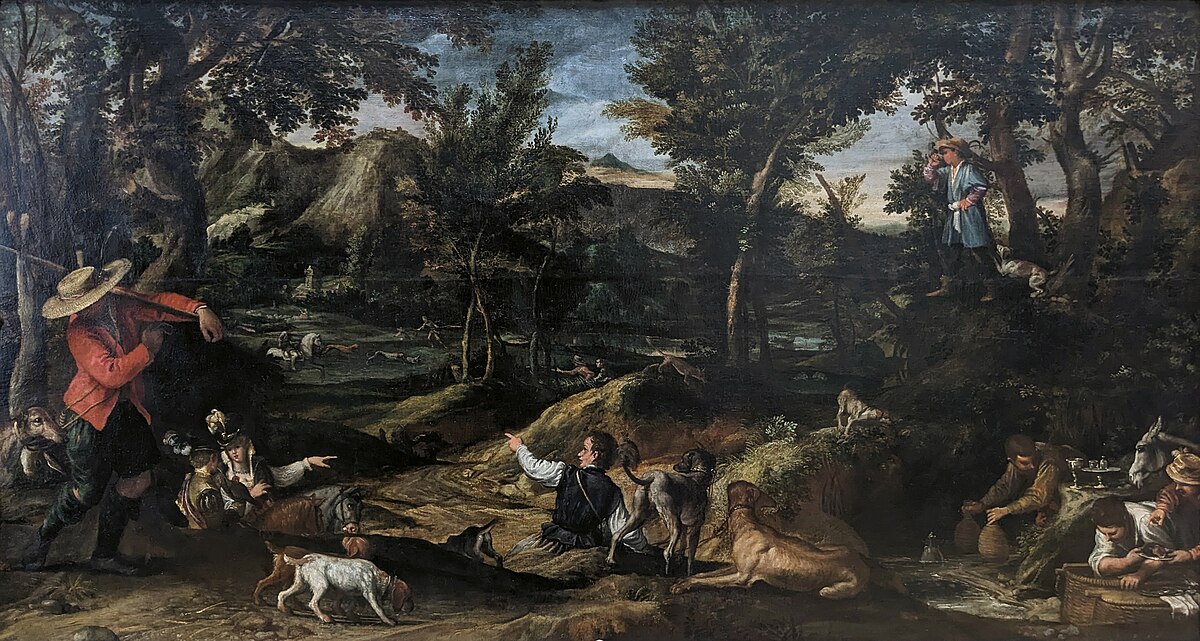
Italian artist Annibale Carracci painted this expansive hunting scene before 1595, during his Bolognese period. The large canvas, measuring 136 by 253 centimeters, depicts aristocrats and common folk alike engaged in the pursuit. Dogs, hunters, and forest fill the composition, which divides into distinct zones of activity. It might be said that with paintings like this, Carracci invented landscape as a subject for Italian Baroque painting.
This work arrived in France when Prince Camillo Pamphili gave it to Louis XIV in 1665. Along with its companion piece "Fishing," it received sumptuous gilt frames decorated with hunting attributes. These frames, among the finest from the Louis XIV period, remain with the paintings today. Charles Le Brun included both works in his 1683 inventory.
The Louvre in Paris now displays this work, where visitors can see how Carracci appreciated nature for its own sake rather than merely as backdrop. His experiments here foreshadowed Poussin's classical landscapes while drawing from the Bassani family's popular tradition of animated countryside scenes.