Wikimedia Commons • Public Domain
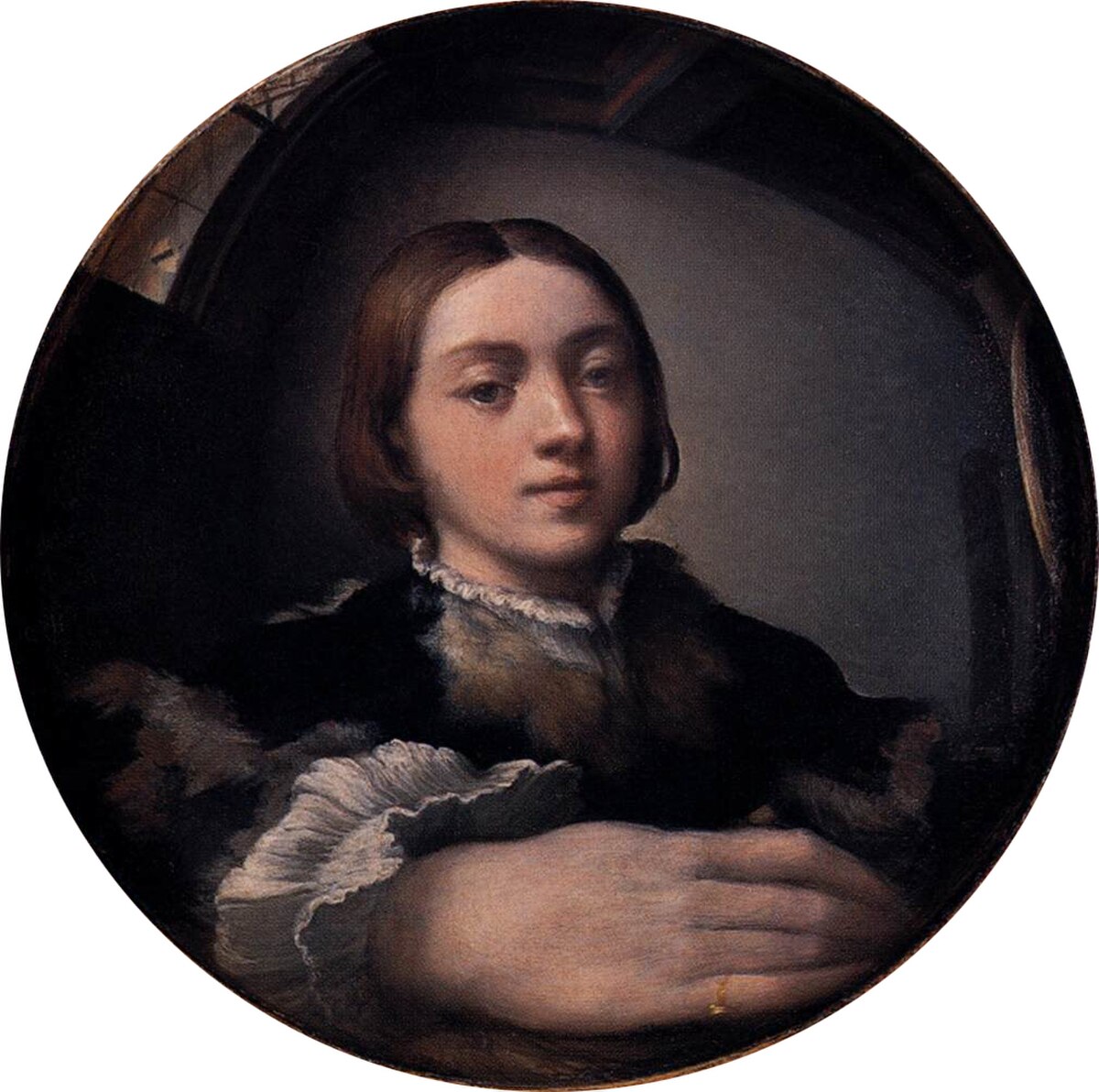
Self-portrait in a Convex Mirror
by Parmigianino
Parmigianino made this self-portrait around 1524 when he was just twenty-one years old, painting his reflection as seen in a barber's convex mirror. To heighten the illusion, he painted on a specially prepared curved wooden panel that mimics the mirror's shape. The result is startling: his hand looms enormously in the foreground while his face recedes smoothly in the center.
The young artist made this tour-de-force to impress Pope Clement VII during a visit to Rome. It worked. The technical virtuosity demonstrated both artistic skill and intellectual sophistication, playing with Renaissance ideas about perception, reality, and the nature of representation itself. Giorgio Vasari wrote that the painting seemed "more real than reality."
Centuries later, American poet John Ashbery wrote a long meditation on this painting, "Self-Portrait in a Convex Mirror," which won the Pulitzer Prize, National Book Award, and National Book Critics Circle Award in 1976. The work continues to inspire artists and writers exploring questions of identity and perception. The original now hangs at the Kunsthistorisches Museum in Vienna, a landmark work of Mannerist invention.