Georgia O'Keeffe
American·1887–1986
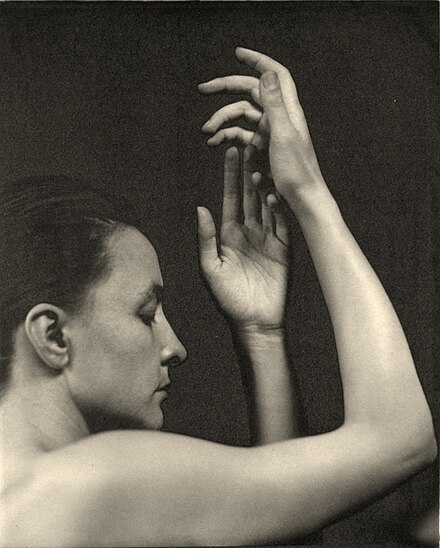
Called the "Mother of American modernism," Georgia O'Keeffe (1887-1986) developed a distinctive visual language that transformed flowers, bones, and desert landscapes into bold, semi-abstract compositions. Born on a Wisconsin farm, she studied at the Art Institute of Chicago and the Art Students League in New York before working as a commercial artist and art teacher. In 1916, photographer Alfred Stieglitz exhibited her abstract charcoal drawings without her permission, launching her career and beginning a relationship that led to their marriage in 1924. Her magnified flower paintings from the mid-1920s brought international recognition, their enlarged petals appearing abstract while remaining rooted in careful observation. O'Keeffe helped establish American Modernism as a distinct movement.
O'Keeffe first visited New Mexico in 1929, finding subjects that would define her mature work: sun-bleached animal skulls, adobe churches, and the stark desert terrain around Ghost Ranch. She moved there permanently after Stieglitz's death in 1946, painting the red hills and vast skies for another four decades. Her cow skull paintings combined Southwestern imagery with patriotic overtones, while later works explored the view from airplane windows as she traveled the world. The Museum of Modern Art held a retrospective in 1946, and the Art Institute of Chicago owns her America Windows stained glass panels. The Georgia O'Keeffe Museum in Santa Fe, opened in 1997, holds the largest collection of her work. In 2014, her painting Jimson Weed/White Flower No. 1 sold for $44.4 million, then the highest price paid for any female artist's work.
Notable Works by Georgia O'Keeffe
3 paintings catalogued with museum locations

Museums with Georgia O'Keeffe's Work
3 museums display O'Keeffe's works. Click any museum to see visiting info and the specific works they hold.
Related Artists
Other American Realism artists you might like
About Georgia O'Keeffe
O'Keeffe helped establish American Modernism, creating a distinctly American visual language that blended abstraction with natural forms while remaining independent of European movements. Her future husband Alfred Stieglitz first exhibited her charcoal abstractions at his 291 gallery in 1916, launching her career as a pioneer of American art.
O'Keeffe is famous for magnified flower paintings that fill entire canvases, sun-bleached animal skulls and bones found in the New Mexico desert, southwestern landscapes around Ghost Ranch, and New York City skyscrapers from her early career. She wanted viewers to see flowers as she did, really look at them.
The Georgia O'Keeffe Museum in Santa Fe holds the largest collection with over 3,000 works. Major paintings also hang at the MoMA, the Art Institute of Chicago, and the Met. Her homes at Ghost Ranch and Abiquiú, New Mexico, are open for tours.
O'Keeffe lived in New York from 1918 to 1949, splitting time between Manhattan and Lake George. She spent summers in New Mexico from 1929 onward, captivated by its landscape. After her husband Stieglitz died in 1946, she moved permanently to Ghost Ranch and later Abiquiú, painting the desert until her nineties.
O'Keeffe's career spanned seven decades, from her first charcoal abstractions in 1915 to her final works in the 1980s. Even after losing most of her eyesight in her nineties, she continued working with assistants. She died in 1986 at age 98, having become an American icon and feminist symbol.
In 2014, her 1932 painting Jimson Weed/White Flower No. 1 sold at Sotheby's for $44.4 million, setting the record for highest price paid for any work by a female artist at auction. That record has since been broken, but her market remains strong with paintings regularly selling for millions.
Love Georgia O'Keeffe's Style?
Explore art inspired by American Realism.
Browse Collection