George Romney
British·1734–1802
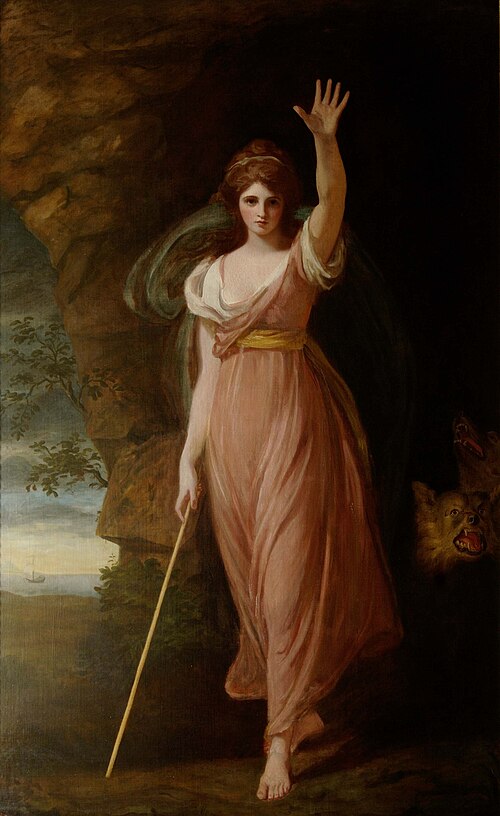
Neoclassical portrait painter George Romney (1734-1802) became one of the most fashionable artists in late 18th-century London, rivaling Joshua Reynolds and Thomas Gainsborough for commissions from aristocratic patrons. Born in Lancashire to a cabinet maker, Romney trained briefly with itinerant painter Christopher Steele before establishing himself in London by 1762. His smooth handling and classical compositions made him a favorite among society clients who appreciated his talent for flattering portraiture without psychological complexity. Unlike his rivals, Romney never exhibited at the Royal Academy, preferring literary circles and maintaining an outsider status throughout his career.
Romney's artistic obsession centered on Emma Hamilton, whom he painted over sixty times between 1782 and 1786 in guises ranging from classical heroines to contemporary beauties. He called her "the divine lady" and these works remain his most celebrated achievements, capturing her theatrical presence with an idealized grace. His portraits now hang in major collections including the National Gallery in London, the Metropolitan Museum of Art, and Tate Britain. Romney's health declined in his final years, and after nearly forty years away, he returned to his wife in Kendal, where she nursed him until his death in 1802. His influence on British portrait painting persisted well into the 19th century.
Notable Works by George Romney
1 painting catalogued with museum locations
Museums with George Romney's Work
1 museum displays Romney's works. Click any museum to see visiting info and the specific works they hold.
About George Romney
Romney worked in the Neoclassical portrait tradition, emphasizing elegant line over color and drawing on Roman classical sculpture for his smooth, idealized compositions. Generally ranked third among late 18th-century English portraitists after Reynolds and Gainsborough, he developed a lighter touch than his rivals, with flowing rhythms inspired by antique statuary.
Major Romney collections are held at the National Gallery in London, Tate Britain, the Metropolitan Museum of Art in New York, and the Huntington Library in California. His hometown of Kendal, Westmorland, preserves works at Abbot Hall Art Gallery.
Romney painted Emma Hamilton over sixty times between 1782 and 1786, portraying her as mythological heroines, classical figures, and saints including Circe, Medea, Cassandra, Joan of Arc, and Nature. He called her 'the divine lady... superior to all womankind.' These portraits of Admiral Nelson's future mistress made both artist and subject famous.
Romney was introspective, preferring literary circles to artist associations. He deliberately avoided the Royal Academy throughout his career, which set him apart from rivals like Reynolds who actively promoted themselves there. This independence may have limited his official recognition, though it didn't prevent commercial success or aristocratic patronage.
Romney was born December 26, 1734, in Dalton-in-Furness, Lancashire, and died November 15, 1802, in Kendal. He left his wife and children in 1762 to pursue his career in London, rarely seeing them for nearly forty years. He returned to his wife only in his final illness, declining from what may have been dementia.
Love George Romney's Style?
Explore art inspired by their style.
Browse Collection