T
© Copyrighted Artwork
This artwork is protected by copyright. We cannot display images of works by artists who passed away after 1954.
See the original at State Hermitage Museum in St. Petersburg
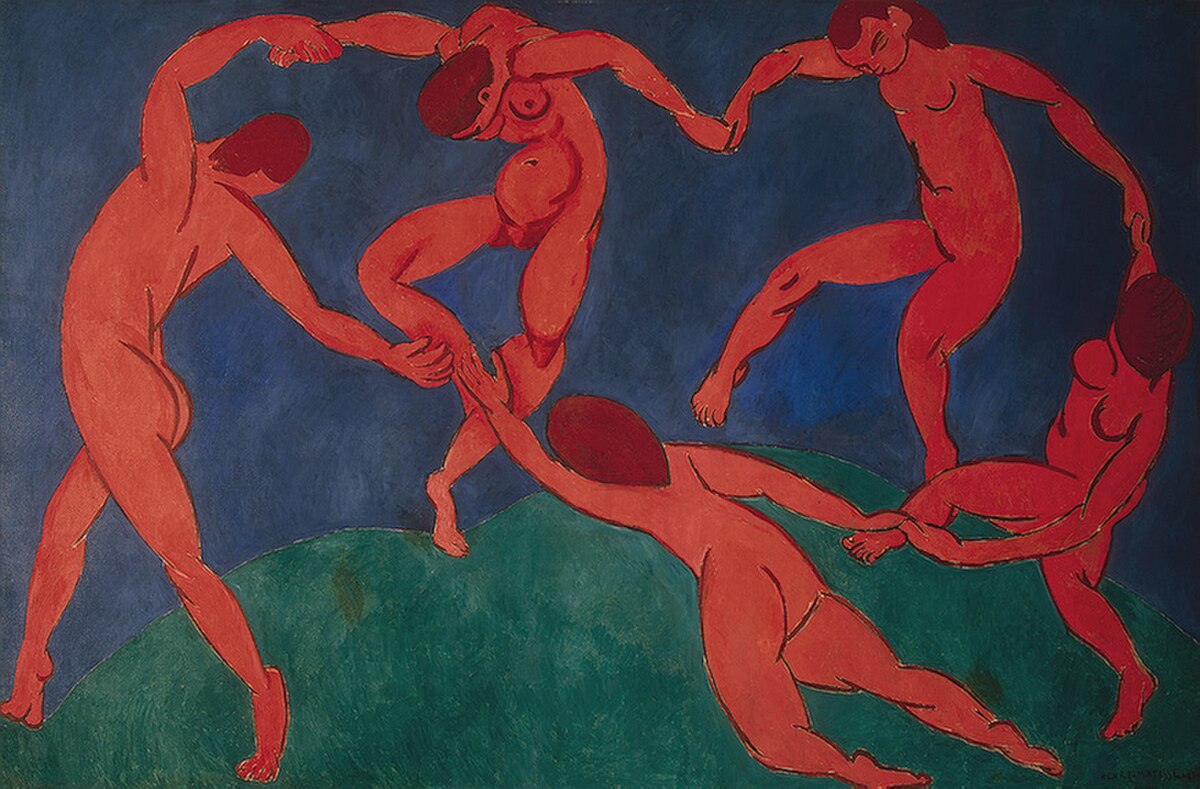
The Dance
by Henri Matisse, 1910
Details
- Year
- 1910
- Medium
- Oil on canvas
- Size
- 260 cm × 391 cm
Henri Matisse painted The Dance in 1910 for Russian collector Sergei Shchukin's Moscow mansion. Five nude figures join hands in a circular dance against a simplified landscape of blue sky and green hill. The flat, intense colors and rhythmic movement epitomize Matisse's Fauve style.
The painting represents Matisse's move toward radical simplification. He reduced the human form to essential curves, eliminated modeling and perspective, and limited his palette to three bold colors: vermillion, blue, and green. The figures seem to pulse with primitive energy, their dance suggesting primal ritual.
Shchukin initially hesitated because the figures' nudity might shock Moscow society, but ultimately installed it in his stairwell alongside its companion piece, Music. After the Russian Revolution, both paintings entered state collections. The Dance now hangs at the Hermitage in St. Petersburg.