Wikimedia Commons • Public Domain
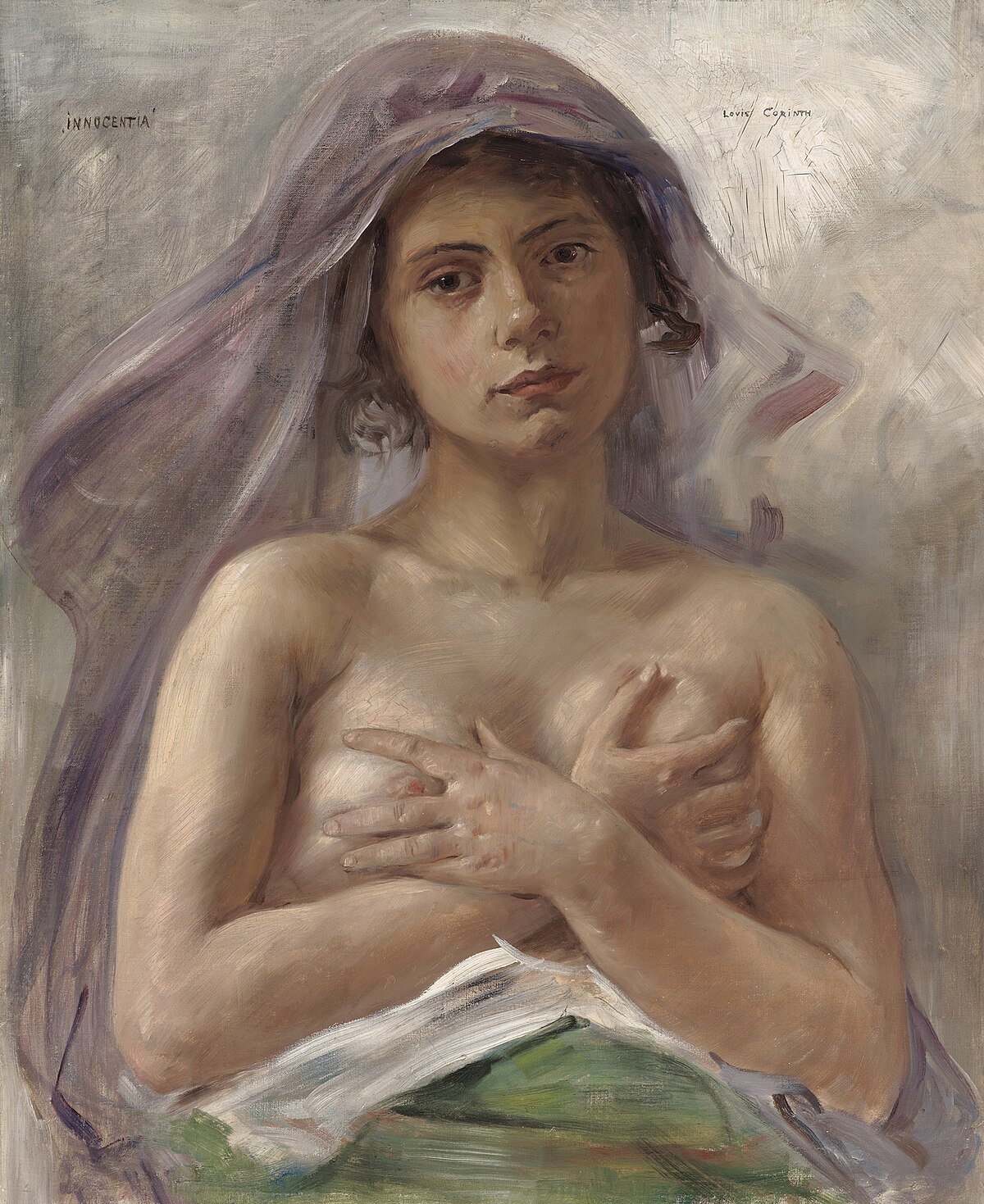
Innocentia
Lovis Corinth painted the Innocentia in 1890, creating a semi-nude portrait that balances vulnerability with quiet defiance. The work depicts a young woman shown frontally, her arms crossed over her chest, wearing only an olive-green garment below her waist and a violet veil that drapes behind her shoulder. Her expression appears melancholic and distant, suggesting thoughts that remain private to the viewer.
Art historians have debated the painting's meaning. Some compare it to depictions of the Vestal virgin, Mary, or the penitent Mary Magdalene. Others point to deliberate contradictions in the composition, noting how the exposed figure and the title "Innocence" create tension. The reference to Raphael's Fornarina, a portrait of the artist's mistress, suggests Corinth may have been playing with the boundary between sacred and profane imagery.
Corinth painted this work during his naturalistic period, before a stroke in 1911 pushed his style toward Expressionism. The painting remained in private hands until the Lenbachhaus in Munich acquired it. The museum first exhibited the work publicly in 1975, and it has since appeared at the Folkwang Museum and other major German institutions.